The queue is not a waiting area. It is a decision point where customers form opinions, staff are tested, and revenue is either captured or quietly lost.
Every business has a moment of truth. It rarely happens in a boardroom or a strategy presentation. It happens at a service counter, in a lobby, at a registration desk - in the queue.
Yet across industries, queues continue to be treated as operational inevitabilities: something to manage reactively, to staff up during peak hours, to apologize for. The deeper problem, unstructured customer flow, stays untouched.
After a decade working with customer-facing organizations, one pattern is unmistakable: the businesses that gain a measurable edge are not the ones with the most staff or the largest floor space. They are the ones that engineer how customers move through their environment. As HBR's landmark piece on managing the end-to-end customer journey notes, organizations that focus only on individual touchpoints often get a distorted and overly optimistic picture of how customers actually experience them.
The cost of poor queue management is not just customer dissatisfaction. It shows up across the P&L.
Revenue lost to abandoned interactions. Staff productivity eroded by unstructured demand. Inconsistent experience across locations. High-value customers treated identically to low-urgency ones. Operational overhead growing without proportional output. The data behind this is sharper than most leaders expect our analysis of how retail stores lose up to 30% of ready-to-buy customers at the checkout queue puts concrete numbers to what often stays invisible on the P&L.
A modern queue management solution addresses this at the foundation, not by making people wait more comfortably, but by transforming customer flow into a structured, measurable system.
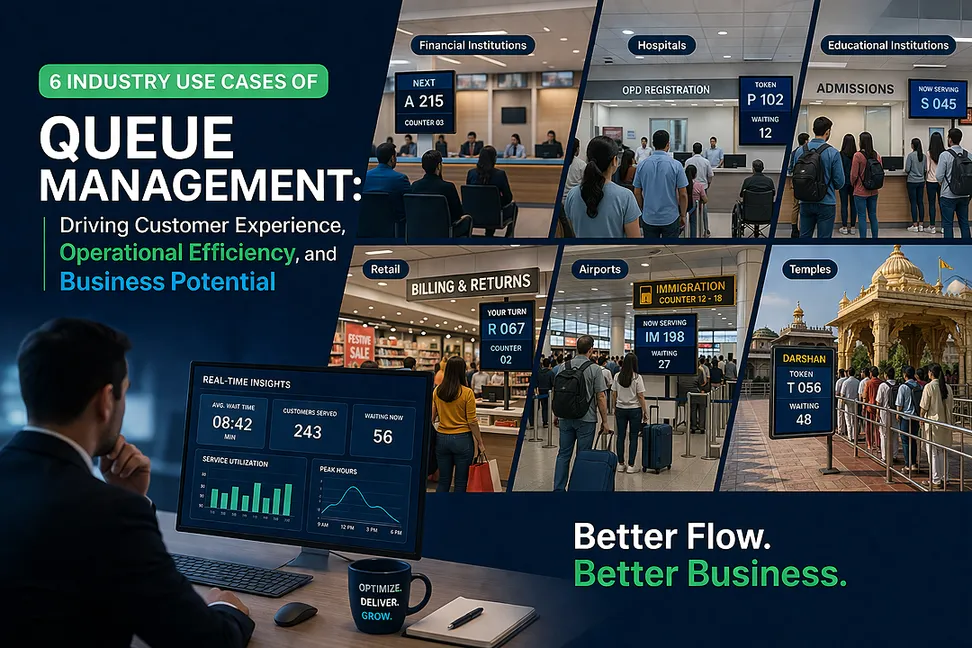
Here is what that looks like across six industries where it matters most.
From queue management to customer flow orchestration. A traditional system organizes people into a line. A modern solution orchestrates how, when, and where customers move through your business connecting customer experience, operational efficiency, and real-time decision-making into one coherent system. For a deeper look at the science underpinning this, our piece on mastering customer experience through queuing theory lays out how predictive models translate into practical staffing and flow decisions.
The industries below each have distinct operating conditions. But the underlying insight is the same: when customer flow is designed rather than managed, the outcomes compound.
Financial Institutions
Where Time Directly Impacts Trust and Revenue
In a bank branch, the queue is not a neutral experience. It shapes the customer's mood before a single word is exchanged with a relationship manager. A customer who waited twenty minutes for a basic service update is unlikely to be receptive to a conversation about a wealth product.
This is the hidden revenue cost of unmanaged branch flow not just dissatisfaction, but missed moments of deeper engagement.
Common friction points
- Walk-ins and appointment customers competing for the same counters
- High-value customers routed through the same queue as routine transactions
- No real-time visibility into workload across service points
Intelligent queue management enables differentiated routing , segmenting customers by service type, appointment status, and priority and gives branch managers live visibility into demand. The outcome is faster service for customers and better utilization of every staff interaction as a potential revenue touchpoint. We examine this in detail in our piece on how smart queue management drives banking loyalty and revenue.
The branch that feels efficient earns the customer's confidence long before the product conversation begins.
Hospitals
When Patient Flow Defines Experience and Efficiency
Hospitals present one of the most complex queue management challenges in any industry not because of volume alone, but because of fragmentation. A patient's journey spans registration, consultation, diagnostics, pharmacy, and discharge. Each of these is often a separate queue, managed by a separate team, with no unified visibility.
The instinctive response to long wait times in healthcare is to add more staff. More registration assistants. More patient coordinators. What this often achieves is more people managing a broken flow, rather than fixing the flow itself. As our analysis of how pre-visit data bottlenecks stifle patient flow shows, high wait times are rarely a clinical capacity issue, they are almost always an administrative data issue.
Where the friction accumulates
- Patients re-entering data at every touchpoint
- No coordination between departments on patient progress
- Waiting areas become bottlenecks because handoffs are invisible
A structured patient flow system connects departments into a single orchestrated journey. Handoffs become visible. Bottlenecks surface before they compound. Patients spend less time confused and more time being served.
Reducing patient anxiety is not a soft outcome , it is a measurable signal of operational coherence.
Educational Institutions
Where First Impressions Shape Long-Term Perception
The admissions hall is a critical brand touchpoint. For a prospective student or parent, the experience of navigating a registration process — physical or hybrid — forms their first judgment of an institution's operational culture.
Today's students arrive with benchmarks shaped by seamless digital experiences. They are accustomed to instant confirmations, predictable timelines, and systems that anticipate rather than react. When they encounter a slow, paper-based, visibly disorganized queue, the institution registers not as traditional but as behind.
Where the experience breaks down
- Admissions, fee payment, and document verification running in parallel with no coordination
- Students waiting with no indication of their position or expected time
- Administrative staff overwhelmed on peak days, disengaged on off-peak ones
Structured scheduling and transparent service queues transform these interactions from friction points into proof of institutional quality. When the administrative experience is smooth, it reinforces the promise the institution has already made in its communications.
Operational efficiency at the front desk is, in this context, a form of institutional reputation management.
Retail
Managing Peak Demand in an Experience-Driven Environment
Retail operates at two speeds: the long arc of brand building and the sharp edge of peak-hour conversion. The queue sits squarely in the second category — and it is where purchase intent is most fragile.
During festivals and high-footfall periods, even well-designed stores can lose customers who are ready to buy. Not because of product availability, not because of pricing — but because the path from decision to transaction is too slow and too uncertain. Customers abandon carts at the physical equivalent of the checkout page. Our deep-dive on dynamic routing and retail analytics for zero-wait CX shows how real-time orchestration of the customer journey eliminates this friction during peak demand.
The peak-hour breakdown
- Billing queues spill into the shopping floor, discouraging other customers
- Staff are pulled to problem areas rather than deployed proactively
- No mechanism to engage waiting customers — dwell time is simply lost time
Structured queue management during high-footfall periods enables retailers to turn wait time into engagement time, optimize counter staffing based on live demand, and protect the quality of the in-store experience at the moments that matter most for conversion.
In retail, the last hundred meters of the customer journey — from product to payment — determine whether the brand promise holds.
Airports
Where Queue Experience Defines the Journey
Airports are architecturally designed for movement. But queues, when unmanaged, work against that architecture at every critical point — immigration, baggage claim, transfer desks, check-in counters, and lounges.
A traveller who has just completed a long-haul flight arrives depleted. Their tolerance for ambiguity is low. A queue without visible structure, without any indication of progress, registers not as a minor inconvenience but as a systemic failure of the airport's promise to facilitate movement.
Where congestion compounds
- Multiple simultaneous flights creating unpredictable footfall surges
- No real-time signalling to distribute load across available service points
- Staff allocation driven by historical patterns rather than live demand
Passenger flow management at scale requires systems that provide real-time visibility, dynamic routing, and predictive staffing. When this works, the experience for the passenger shifts from endurance to expectation — they know where they are, what comes next, and approximately how long it will take. McKinsey's research on next-generation operating models found that airport passengers consistently preferred knowing their wait time over simply having a shorter one — a distinction that has direct implications for how queue systems should be designed.
Operational consistency under high volume is what separates a well-regarded airport from one that simply processes passengers.
Temples
Managing High-Volume Devotion with Structure and Respect
Temples operate under conditions unlike any other institution managing queues. The devotee arrives not as a customer transacting for a service, but as a person carrying emotional and spiritual weight. The quality of their experience — the sense of order, dignity, and care — matters in a way that extends beyond operational metrics.
During peak periods — major festivals, auspicious days, pilgrimage seasons — the scale of footfall at prominent temples rivals that of large airports or stadium events. The challenge is compounded by the fact that demand is largely unpredictable and the consequences of poor management extend to safety.
The unique complexity
- Extreme footfall surges with minimal advance signal
- Mixed queue categories — VIP darshan, general entry, special puja bookings — often without clear delineation
- Crowd congestion creating both experience degradation and genuine safety risk
Structured queue systems for temples — segmented entry, timed slots, real-time crowd visibility — do not diminish the sanctity of the experience. They protect it. When devotees can proceed through their visit with clarity and without physical stress, the spiritual dimension of the experience is actually enhanced. We explore what this looks like in practice in our 2026 guide to designing devotee experience at scale.
Crowd management at a temple is not logistics. It is an act of institutional care for every person who arrives.
The Queue Is a Strategic Control Point - Not an Operational Afterthought
Across these six industries, the context changes substantially. The stakes are different. The customer is different. The operational complexity is different. But the underlying truth is consistent: the queue is where business performance is determined, not just reflected.
Organizations that treat customer flow as a strategic system — rather than a byproduct of footfall — gain something measurable: better staff utilization, more predictable customer outcomes, and the ability to prioritize where it matters most.
| Operational | Experience | Commercial |
| Structured demand and optimized staffing replace reactive headcount decisions. | Transparency and predictability replace ambiguity — and ambiguity is what customers remember negatively. | Better flow creates more conversion moments, more engagement time, and more consistent service quality at scale. |
The shift from reactive queue management to engineered customer flow is no longer the domain of large enterprises with large budgets. It is now accessible, measurable, and increasingly expected — by customers who have grown accustomed to systems that work, and by organizations that can no longer afford the hidden costs of systems that don't.
Ready to engineer your customer flow? If your business serves customers in physical or hybrid environments, it's time to move beyond managing queues, and start designing the experience.