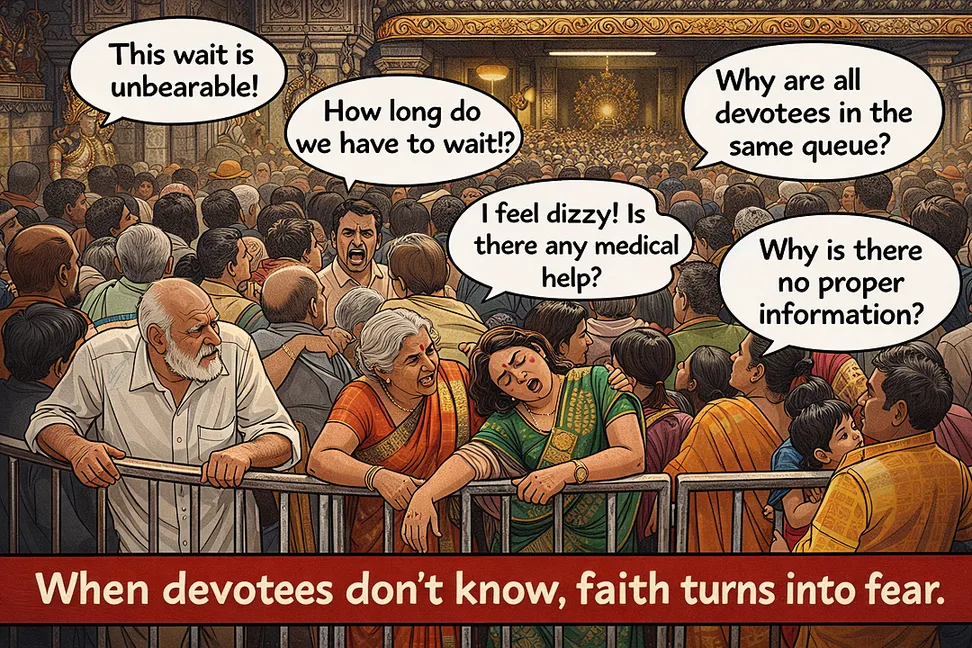
A New Standard for Sacred Spaces
In 2026, the measure of a temple’s success is no longer just the volume of its devotees, but the dignity of their journey. As global footfalls at religious sites now rival international airports, the transition from crowd control to experience orchestration is the only way to protect both pilgrim safety and ancient sanctity.
For temple boards, Devaswoms, and trust administrators, this shift is no longer optional—it is a governance responsibility.
Secure Your Temple’s Future: Explore a Humane, Data-Led Queueing Framework
When Faith Meets Flow
For centuries, temples have stood at the heart of community life—not merely as places of worship, but as living repositories of history, culture, and architectural marvel. Today, that significance has grown. Improved connectivity and digital access have turned local spiritual journeys into global pilgrimage events.
This surge brings responsibility. When crowds swell without a scientific Temple Crowd Management System, moments meant for peace turn into tests of physical endurance.
Recognizing this reality, the Kerala High Court recently directed the Guruvayur Devaswom to implement a comprehensive crowd management plan, emphasizing humane measures that protect devotee dignity.
At VirtuaQ, we believe that managing devotional flow is more than operational—it is an act of seva (service) that preserves cultural heritage.
Why Temple Crowd Management Is a Matter of Trust
Trust is the currency of devotion. Today’s tech-aware devotees arrive with expectations shaped by transparency and predictability.
As explored in our earlier deep-dive, Why Temples Must Rethink Queue Management, a devotee’s lasting memory is shaped not only by darshan, but by how they were treated in the hours leading up to it.
Uncertainty erodes trust faster than the wait itself.
A modern Temple Queue Management System must therefore address the silent stress that ripples through a crowd:
- The elderly, who deserve to complete their pilgrimage with physical dignity
- Parents, managing restless children in dense corridors
- Pilgrims, who travel thousands of miles only to feel trapped in unmoving lines
Predictability reduces anxiety.
Transparency builds trust.
Humane flow preserves sanctity.
Visibility as Compassion: Knowing What Lies Ahead
As Neel puts it:
“The most distressing part of a queue isn’t the duration; it’s the lack of data.”
Modern Darshan Queue Systems introduce visibility as compassion through:
- Indicative wait times at entry points to set expectations
- Digital progress tracking via display boards showing real movement
- Omnichannel updates (SMS / WhatsApp alerts) that free devotees from standing in stagnant lines, allowing them to appreciate temple architecture and open spaces
Information calms the mind long before the body moves.
Inclusive Queue Design: One Faith, Different Needs
Equality does not always mean uniformity.
An empathy-led Temple Crowd Management approach recognizes that different devotees have different physical thresholds. Controlled, time-bound entry blocks allow administrations to prioritize senior citizens and the differently-abled without disrupting overall flow.
Dedicated holding areas with seating and hydration are not “amenities”—they are essential design choices that reduce fatigue and prevent panic-driven surges, especially during peak festivals.
Predictive Planning: Data as a Silent Guardian
By 2026, the gold standard for Religious Site Crowd Management involves predictive intelligence rather than reactive enforcement.
Data-led systems enable administrations to:
- Anticipate surges by forecasting peak devotion days
- Dynamically regulate flow based on real-time density within temple architecture
- Stagger entries into manageable, monitored batches
When data works quietly in the background, devotion remains undisturbed in the foreground.
Designing Darshan with Dignity
Massive crowds are a testament to faith. Unmanaged crowds can unintentionally betray that faith.
A well-orchestrated Temple Queue Management System ensures that:
- Devotees feel informed, not ignored
- Safety is achieved through foresight, not force
- The sacred experience remains intact—even at scale
At VirtuaQ, we approach temple management with deep respect for tradition, helping bridge ancient heritage with future-ready pilgrim flow management.
Is your temple prepared to welcome the 2026 surge with dignity, safety, and reverence?
Explore VirtuaQ’s Temple Management Framework and design temple visits that honour devotion at scale.