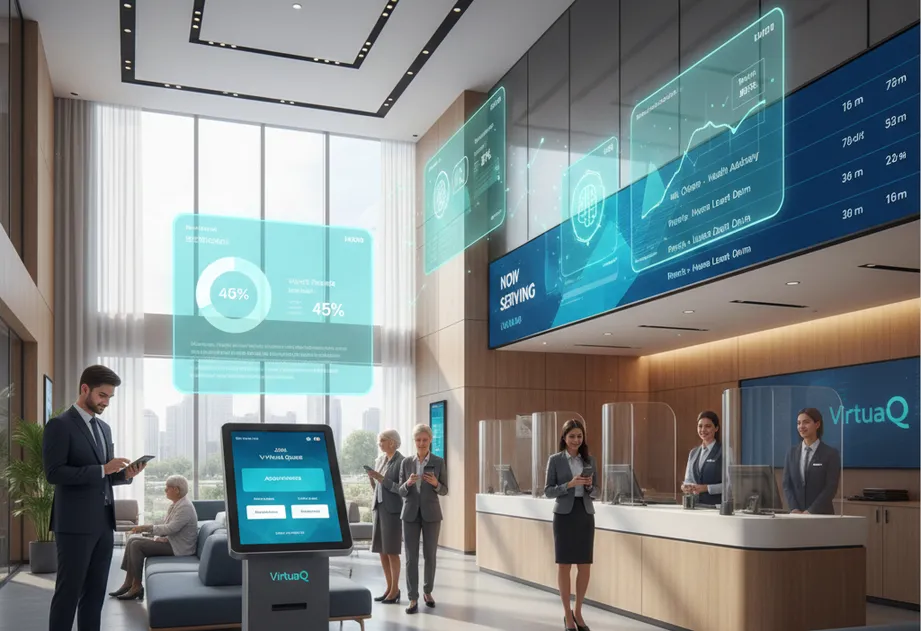
The Paradox of the Digital-First Branch
In an era of hyper-digitalization, bank branches are undergoing a radical transformation. While mobile apps handle the "everyday," the physical branch has become the sanctuary for high-value, high-trust interactions—mortgages, wealth advisory, and complex corporate banking. Yet, a glaring gap remains: banks spend millions on premium lounge designs only to have their most valuable VIPs wait in the same unpredictable queues as walk-in customers. Customer Experience (CX) in banking is no longer just about the app interface; it’s about customer journey orchestration in the physical space. If your branch strategy doesn't include intelligent queue management, you aren't just losing time, you’re losing customer lifetime value.
Is your branch experience matching your brand promise? See how VirtuaQ orchestrates premium banking journeys
Why the Branch Still Matters in a Digital-First World
Digital banking has automated the "transactional," but it has not replaced the "relational." Customers still visit branches for high stakes moments:
- Secured Lending: Home and gold loans that require physical verification and trust.
- Wealth Advisory: Complex financial planning that demands a face-to-face relationship.
- Problem Resolution: Escalations where a chatbot simply won't suffice.
In these moments, the wait time is a direct signal of how much the bank values that specific individual. This makes bank queue management a frontline driver of loyalty and a critical tool for hospitality-grade CX.
The Hidden CX Gap: Modern Decor vs. Legacy Queues
Walk into any modern flagship branch today, and you’ll see premium interiors and LED screens. However, the underlying "engine" is often still a legacy, first-come-first-served token system.
This creates a "Hidden CX Gap" where:
- High-Value Customers are treated with the same priority as low-value, transactional walk-ins.
- Relationship Managers are blindsided by unscheduled arrivals, disrupting booked appointments.
- Branch Managers lack real-time visibility into "load," leading to chaotic lobbies during peak hours.
From Lines to Logic: AI-Supported Orchestration
Traditional queue management systems (QMS) are reactive. Modern intelligent queue management is predictive and strategic. By replacing static tokens with AI-supported flow, banks can finally align service delivery with customer value.
Key Technology Trends for 2026:
- Virtual & Mobile Queuing: Allowing customers to join the queue via WhatsApp or the bank's app, effectively "removing" the physical waiting room.
- AI-Driven Segmentation: Automatically recognizing a premium account holder the moment they check in and routing them to a dedicated Relationship Manager.
- Appointment-Walk-in Blending: Intelligently "slotting" walk-ins around scheduled appointments to ensure maximum staff productivity without delaying VIPs.
The VirtuaQ Advantage: Orchestrating the Premium Journey
As a strategist, I see VirtuaQ as the bridge between a bank's CRM and its physical operations. It transforms the lobby from a waiting area into a high-performance service zone.
How VirtuaQ Empowers Banking Leaders:
- For CX Officers: Provides real-time "Lobby Health" metrics, allowing for proactive intervention before a delay turns into a complaint.
- For Branch Heads: Delivers data on staff efficiency and service-level agreement (SLA) breaches across the entire network.
- For the Customer: Offers a transparent, respectful experience with real-time SMS updates and mobile check-ins.
Strategic Impact: Traditional vs. Intelligent Banking QMS
| Strategic Pillar | Traditional Token Systems | VirtuaQ Journey Orchestration |
| VIP/Priority Handling | Manual and inconsistent | Automated & CRM-integrated |
| Customer Visibility | "Your number is 104" | "You are next; your advisor is ready" |
| Staff Utilization | Random and reactive | Balanced & Data-driven |
| Revenue Link | None (operational only) | High (Cross-sell opportunities) |
| Network Standards | Branch-by-branch variance | Centralized, uniform CX standards |
The Bottom Line: Waiting is a Revenue Lever
Banks that implement advanced queue management systems consistently report a 4–8% revenue uplift. Why? Because when customers feel respected and their time is valued, they are more receptive to advisory services, cross-selling, and long-term brand advocacy.
Conclusion: Orchestrating the Future
Modern banking requires more than just digital tools; it requires an intelligent physical presence. By adopting smart queue management, banks move beyond simply "managing lines" to orchestrating premium, empathetic experiences that define the brand.
The future of the branch isn't just about being "paperless"—it’s about being "frictionless." Talk to your CX Strategist at VirtuaQ to know more