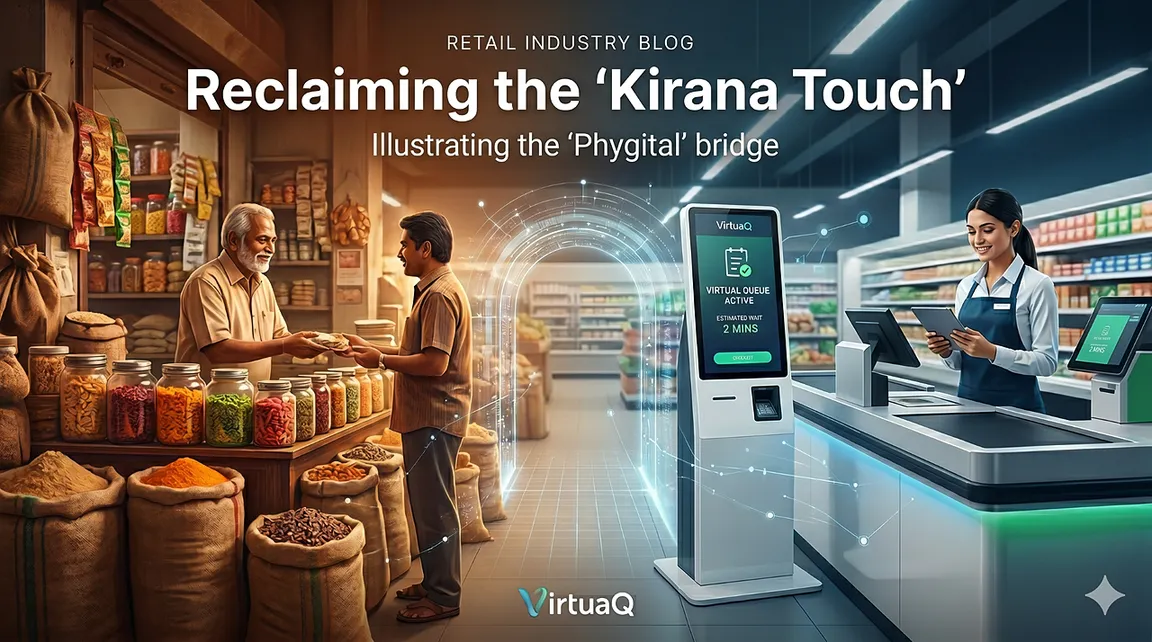
There was a time when retail didn't need a strategy for waiting.
In the neighbourhood Kirana store, waiting wasn't a friction point , it was part of the rhythm. The shopkeeper knew your name, knew what you'd bought last week, and had already set aside the brand of oil your mother preferred. If someone was ahead of you, you didn't disengage. You chatted, you browsed, you felt like a guest rather than a transaction in progress.
That model scaled on trust. And for decades, it worked beautifully.
Then modern retail arrived - with its wide aisles, barcode scanners, and efficient billing lanes. It brought scale, variety, and speed. What it couldn't quite carry across was the thing the Kirana store had always offered for free: the sense that your time mattered.
The Final Mile Is Leaking
Here is what the data tells us, and what most retailers quietly know: a meaningful share of customers who walk into a store, select a product, and intend to buy, don't. They leave. Not because they changed their minds. Because they calculated the cost of the queue against the value of the purchase, and the queue won.
A 2025 Waitwhile Consumer Survey found that 41% of consumers continue to browse or shop while waiting in a virtual queue, turning what was dead time into active floor time, and active floor time into revenue
For a store doing serious footfall numbers, these aren't rounding errors. They're a revenue line that doesn't show up anywhere , not in the POS report, not in the daily summary, not in the marketing analytics.
The footfall counter recorded them. The billing system never did.
This is the invisible exit: customers who were already converted, lost at the very last step.
The Real Cost Isn't the Walk-Away. It's the Invisibility.
What makes this leak so persistent is that it doesn't hurt loudly. There's no error code, no failed transaction, no customer complaint logged. The store just ends the day with slightly lower conversion than it should have, and no clean explanation for why.
Traditional retail systems are engineered around throughput, how many items can be scanned per minute, how many lanes can be opened during peak hours. These are legitimate operational questions. But they're the wrong lens for understanding what a customer actually experiences while waiting.
Standing in a physical line is cognitively expensive. The customer has stopped browsing. They've stopped deciding. They're just waiting and they're watching the minutes go by with nothing to show for it. Every additional minute in that static line is a minute they're calculating whether this purchase is worth it.
The queue, in other words, isn't just a bottleneck. It's an active disengagement engine.
What Changes When You Treat Time as the Product
The shift that modern retail needs isn't primarily about speed. It's about restoring something the Kirana store never lost: the customer's sense of agency over their own time.
When a customer can check into a queue digitally via a QR code, receive a real-time position update on their phone, and use that window to keep browsing, the experience transforms. The wait doesn't disappear, but it stops being dead time. It becomes time they control.
This distinction between time that is wasted and time that is used, is where revenue recovery happens. A customer who is still on the floor, still engaging with inventory, still in a buying mindset, is a customer who is still your customer.
Research published in the Harvard Business Review found that customers who receive accurate wait estimates and then experience a wait that beats that estimate report meaningfully higher satisfaction and loyalty than those given no information at all. The insight is consistent: transparency about waiting changes the experience of waiting, independent of how long the wait actually is. This is the lever that smart queue management pulls, not just reducing the queue, but restructuring the customer's experience of it.
(Source: "When Providing Wait Times, It Pays to Underpromise and Overdeliver" - Harvard Business Review, 2020)
Several retailers who have deployed smart queue management systems ,including implementations we've been part of at VirtuaQ across supermarkets and specialty retail have found that dwell time increases meaningfully once customers are untethered from the physical line. And dwell time, as any retail operator knows, is one of the most reliable predictors of basket value.
Related reading: How Smart Queue Management Eliminates Retail Friction and Delivers Superior CX
The Operational Side of the Equation
There's a second effect that rarely gets discussed in the CX conversation: what a well-managed queue does to your staff.
Billing staff working a chaotic, unmanaged line are not just processing transactions , they're absorbing frustration. Customers arrive at the counter already annoyed, already rushed, and often already disengaged from the brand. That emotional residue is real, and it affects the quality of every interaction.
A staff member receiving a customer who has been engaged, informed, and kept in control of their wait arrives at a fundamentally different moment in the customer journey. The final touchpoint, the one the customer will actually remember, becomes a closing experience rather than a damage-control exercise.
This shows up in service quality scores, in staff retention, and in the subtle but measurable difference between a customer who leaves satisfied and one who leaves merely relieved.
What is smart queue management in retail?
Smart queue management in retail is a system that moves customers out of physical checkout lines and into digital queues, typically via QR code or mobile so they can continue browsing while they wait. It reduces checkout abandonment, increases dwell time on the floor, and gives retailers real-time visibility into queue load and staffing needs. For stores with high footfall, it is one of the fastest levers for recovering lost conversion at the billing counter.
The Metric That Retail Has Been Missing
What is queue abandonment costing your store? Most retail KPIs are built around what happened: transactions completed, revenue per square foot, units sold per hour. These are lagging indicators, they tell you what your store did, not what it almost did.
The queue abandonment rate is a leading indicator of conversion health. It tells you how many customers you were one step away from winning and didn't. Tracking it, understanding its peak patterns, and designing your queue management system against it is increasingly the work that separates good retail operators from great ones.
The stores that will define the next decade of retail are the ones building systems that treat customer time as a resource to be respected, not a by-product to be managed. The Kirana store understood this intuitively. Modern retail is finally building the infrastructure to catch up.
Related reading: Queue Management and Queuing Theory: What Every Retail Operator Should Know
VirtuaQ works with retailers to design queue and customer journey systems that close the gap between footfall and conversion. If this is a challenge your stores are navigating, we're happy to think through it with you. Book a Conversation with the VirtuaQ team