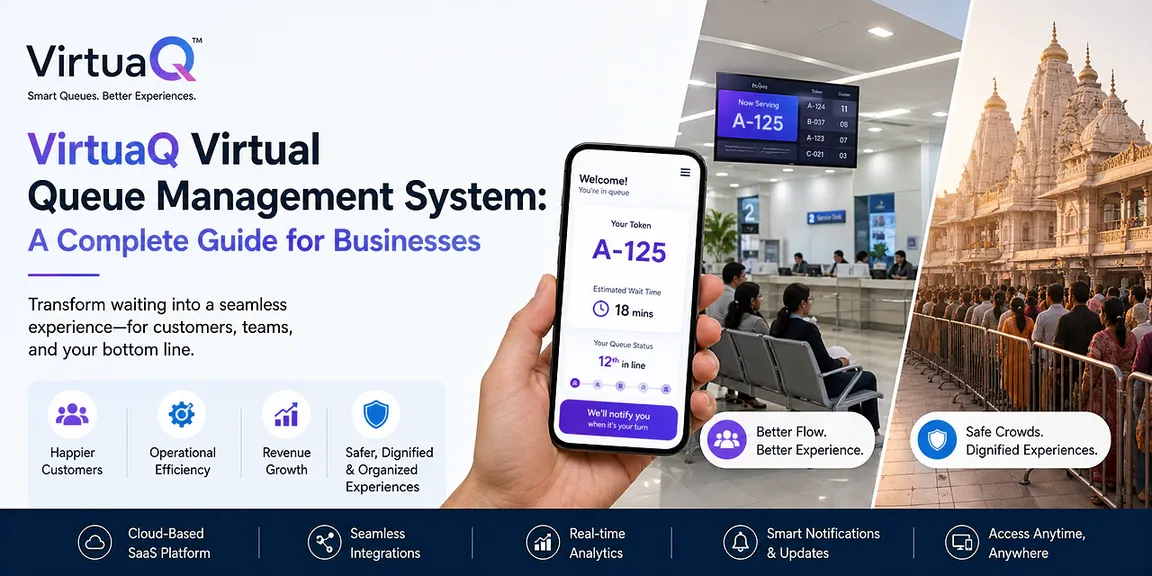
Waiting is no longer a physical necessity; it is a digital choice. For modern enterprises, long physical lines are an operational failure that bleeds revenue, tanks Net Promoter Scores (NPS), and drives customers straight to competitors.
This comprehensive guide explores how a cloud-native virtual queue management system and customer journey orchestration transform chaotic waiting areas into structured, data-driven customer flows across multiple inbound channels.
👉 Ready to eliminate checkout fatigue and walkaways? Book a VirtuaQ Live Demo Today
To optimize customer flow, enterprises must first understand the behavioural science of waiting. David Maister’s Laws of Service dictate that customer satisfaction is a math equation:
Satisfaction = Perception - Expectation.
Traditional linear queuing fails because it fundamentally mismanages the psychology of the wait in three distinct ways:
- Unoccupied Time Feels Longer Than Occupied Time: Forcing a customer to stand in a rope line creates "dead time." When a customer joins a digital line via an omnichannel virtual queue management system, their time is occupied with their own life, browsing, working, or relaxing, which drastically reduces perceived wait times.
- Anxiety Makes Waits Seem Longer: Lack of transparency breeds friction. Without real-time updates, customers constantly wonder, "Did they skip my token?" or "How much longer will this take?"
- Unfair Waits Destroy Brand Loyalty: Seeing a walk-in cut ahead of a scheduled appointment without explanation triggers immediate customer churn.
By deploying a cloud-based virtual queue management system (VQMS), businesses decouple the act of waiting from physical presence. This strategy directly leverages David Maister’s foundational research on The Psychology of Waiting Lines, converting anxious waiting rooms into efficient, self-orchestrated customer journeys.
2. What Is a Virtual Queue Management System?
At its core, an enterprise virtual queue management system is a hardware-agnostic, cloud-native software architecture that allows customers to secure a service token, track their line position, and receive call-forward notifications directly through their preferred mobile device, web browser, or messaging application.
Unlike legacy hardware systems that rely heavily on dedicated physical kiosks, thermal ticket dispensers, and localized on-premise servers, a software-as-a-service (SaaS) customer flow solution operates entirely in a synchronized cloud environment. It acts as an integration hub for multiple interactive check-in options, including QR code scans, web-based appointment booking, SMS tokens, and automated WhatsApp workflows.
The Core Tech Stack of Modern Customer Flow Management:
- Digital Token Generation: Instantaneous issuance of virtual tickets via mobile web paths, native apps, or unified communication gateways.
- Real-Time Wait Time Analytics: Algorithmic calculation of Estimated Wait Times (EWT) based on live counter transaction speeds and active staff counts.
- Just-In-Time (JIT) Notifications: Automated mobile push alerts, text messages, or web notifications that alert the customer precisely when their designated service desk is ready.
3. Core Features of an Intelligent Virtual Queuing System
VirtuaQ does not simply digitize a broken physical line; it replaces it with an intelligent routing engine driven by automation. A robust enterprise deployment requires several non-negotiable architectural components:
A. Omnichannel Customer Touchpoints
A customer’s journey can begin from home or on-site. The platform must unify all entry channels into a single, synchronized database:
- Remote Pre-Booking: Web portals, corporate websites, or mobile apps that allow users to book a slot before arriving.
- On-Site QR Scanning: Contactless check-in posters located at the entrance for immediate walk-ins.
- Omnichannel Messaging: Chatbot or text integrations (like WhatsApp or native SMS) that issue tokens through text threads.
- Self-Service Kiosks: Touchscreen hardware integrations for non-digital or elderly citizens who still require a physical ticket.
B. Intent-Based Routing & Skill-Based Slicing
Traditional First-In, First-Out (FIFO) models create massive bottlenecks. If a bank customer wanting a simple cash deposit gets stuck behind a client negotiating a complex commercial mortgage, operational efficiency plummets.
VirtuaQ uses Intent-Based Routing. When a customer checks in via any digital channel, the system captures their specific service requirement. The workflow orchestration engine then applies advanced logic:
- Skill-Based Routing: The customer is automatically funneled to an employee qualified to handle that specific transaction.
- Priority Slicing: High-Net-Worth (HNW) individuals, scheduled appointments, or emergency patients are escalated automatically via backend SLA rules.
- Fast-Track Slicing: Low-complexity, high-velocity tasks (e.g., picking up a renewed debit card or an online order) bypass the primary queue entirely.
C. Real-Time Centralised Dashboard & Analytics
Branch managers and enterprise executives gain a bird's-eye view of organizational efficiency. Cloud-native systems compile real-time service metrics, including:
- Average Wait Time (AWT) per branch, service category, or employee.
- Customer Abandonment Rate ("Balking" and "Reneging" metrics).
- Employee Service Rate to track counter-level productivity.
4. Enterprise Use Cases: Banking, Healthcare, and Retail Playbooks
| Industry Vertical | Legacy Queuing Bottleneck | The VirtuaQ System Transformation | Key Business Metric | Impact also in |
| Retail Banking | High-value clients walking away due to visible checkout fatigue and crowded branch lobbies. | Priority Routing: HNW clients check in remotely or via QR, are recognized by CRM integration, and are routed to private lounges seamlessly. | 22% Reduction in Branch Abandonment | Increased Cross-Selling Opportunities |
| Healthcare & Clinics | Overcrowded outpatient department (OPD) waiting rooms causing severe cross-infection risks and poor patient experience. | Remote Patient Check-In: Patients register from their vehicles or nearby cafes via SMS/Web. They receive a notification when the doctor is exactly one appointment away. | 40% Drop in Waiting Room | Reduced Congestion∙ Higher Patient NPS |
| Big-Box Retail | Abandoned shopping carts at checkout lanes during peak hours or seasonal sales events. | Scan & Shop Workflows: Shoppers scan a QR code upon entering the store to join a virtual billing line while continuing to browse product aisles. | 15% Increase in Average Order Value (AOV) | Elimination of Cart Abandonment |
| High-Density Public Sites & Temples | Stampede risks, safety hazards, and compromised sanctity due to thousands of unmanaged visitors. | Dignified Flow Slots: Devotees use a integrated web or mobile bot to book time-stamped virtual tokens, enforcing a smooth, continuous pedestrian flow. | 100% Elimination of Physical Crowding | Enhanced Public Safety |
5. Linear Queuing vs. Virtual Queuing: The ROI Breakdown
Many enterprise procurement officers make the mistake of buying legacy hardware-heavy systems (on-premise servers, media players, proprietary wiring) instead of modern SaaS platforms. Let's look at the hard operational differences and return on investment (ROI):
| Feature / Metric | Legacy Linear Hardware | Cloud-Native Software (VirtuaQ) |
| Hardware Footprint | Heavy: Ticket dispensers, LCD displays, physical buttons, media players. | Zero-Footprint: Utilizes customers' mobile screens and staff web browsers. |
| Deployment Speed | Weeks or Months per location; requires physical installation teams. | Days: 100% remote configuration and instant cloud provisioning. |
| Maintenance & Upkeep | High: Continuous hardware repair, thermal paper costs, on-site IT support. | Low: Included in software subscription; automatic over-the-air updates. |
| Data Silos | Data often stored locally on-premise; difficult to aggregate globally. | Centralized cloud dashboard; instant cross-location analytics. |
| Customer Interface | Passive: Looking up at an overhead screen waiting for a number to flash. | Active & Interactive: Direct two-way communication via SMS, Apps, or WhatsApp. |
How VirtuaQ Drives Revenue Multiplication:
- Eliminates "Balking": When consumers see a long physical line, they leave. Data compiled on tech-enabled checkout experiences by McKinsey & Company reveals that mobile queue mechanics drastically eliminate line friction, capturing demand before customers walk away.
- Optimizes Staff Allocation: Real-time analytical data allows enterprise brands to shorten queues and capture up to a 12% reduction in operational labor costs through smarter resource allocation and targeted, hourly employee scheduling.
- Improves Employee Morale: Operational clinical data published by the National Institutes of Health explicitly tracks how digital check-in queues actively change perceived vs. actual wait times, maximizing overall patient and customer satisfaction while shielding on-site staff from waiting room friction.
6. Technical Architecture & Security Compliance
An enterprise visitor management software and queue system cannot be a simple standalone script. It must integrate into your core IT ecosystem without creating vulnerabilities.
- API Integration & CRM Synchronization : VirtuaQ features a robust REST API framework that integrates natively into your existing core systems—whether it’s Salesforce, SAP, core banking software, or Hospital Information Systems (HIS). When a customer inputs their details into the system via an entry channel, the platform cross-references their profile data to instantly surface critical context to the assigned service desk agent.
- Multi-Location Central Management Software (CMS) For enterprises managing hundreds of branches across multiple regions, VirtuaQ provides a centralized control hub. Global permissions, service categories, and automated notification scripts can be modified globally or adjusted at the individual branch level with a single click.
- Enterprise-Grade Data Security Handling customer contact records and service histories requires strict compliance adherence. VirtuaQ is engineered around modern data privacy mandates:
- GDPR & HIPAA Compliance: Full encryption of data both in transit (AES-256) and at rest.
- Zero PII Retention Options: Capability to automatically purge Personally Identifiable Information (PII) post-transaction for high-security environments like healthcare and banking.
7. How to Implement a Cloud Virtual Queue System in 3 Steps
Transitioning your organization away from physical chaos does not require a disruptive construction process or extensive staff retraining.
- Step 1: Map the Customer Journey & Intent Rules Define your core service categories (e.g., Account Opening, Loan Consultation, Cash Transactions) and establish your routing logic. Determine which actions require specialized staff and configure your skill-based slicing thresholds.
- Step 2: Configure Your Digital Touchpoints Deploy your localized web check-in paths, sync your communication channels, and generate your location-specific QR code entry posters to be placed prominently at your facility entrances.
- Step 3: Launch Your Web-Based Staff Dashboard Because VirtuaQ requires zero proprietary hardware, your service agents simply log into a secure web browser dashboard on their existing desktop computers. With an intuitive, one-click interface, they can summon the next customer, put a token on hold, or transfer a complex client to a senior specialist.
Conclusion: Step Into the Future of Customer Flow Optimization
In a hyper-competitive market where customer experience directly dictates business growth, the traditional physical "line" is an outdated liability. By adopting a modern virtual queue management system, you aren't merely buying utility software; you are actively investing in customer respect, employee satisfaction, and operational excellence.
Stop managing lines and start designing seamless customer flows. Join global leaders in banking, retail, and healthcare who have completely eliminated the wait and unlocked the flow.