The Patient Experience (PX) Mandate
In the competitive landscape of modern hospital management, Patient Experience (PX) has shifted from a "nice-to-have" service metric to a core strategic priority. While many institutions focus on bedside manner and clinical excellence, the most damaging friction points are often operational: the agonizing wait, the redundant paperwork, and the lack of communication. Fixing PX requires more than just empathy; it requires patient flow orchestration. By implementing smart queue management for hospitals, healthcare leaders can eliminate the systemic causes of frustration and transform the patient journey from a source of anxiety into a seamless, respectful experience.
Why Queue Management is the Missing Link in Hospital Management
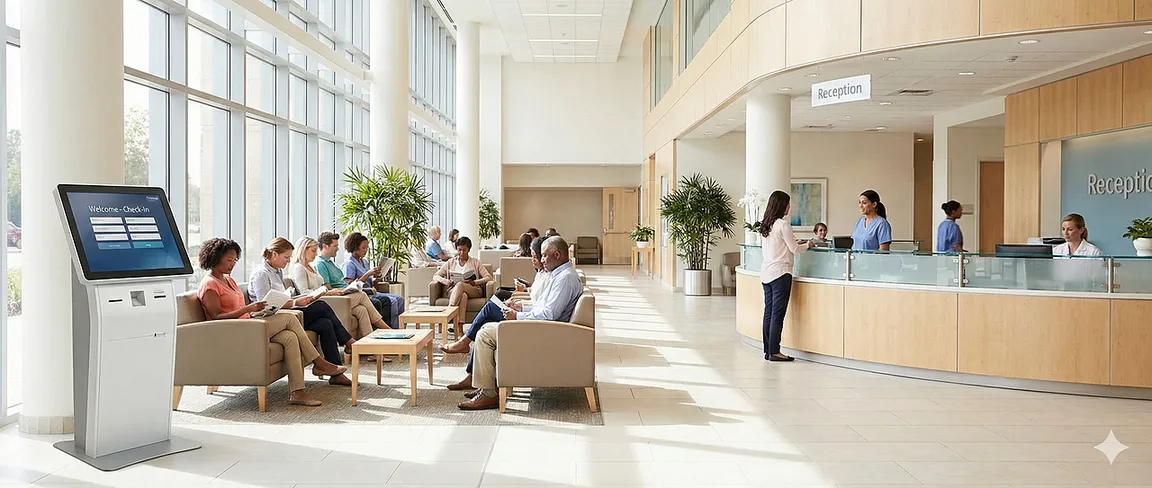
Modern hospitals are architectural marvels, yet the "invisible" infrastructure, the flow of people, is often decades behind. We see hospitals investing millions in lobby aesthetics, only for patients to sit in those lobbies for hours with no information. This is where hospital management strategy often falters.
The frustration patients feel isn't just about the minutes on the clock; it’s about uncertainty and administrative friction. When a patient encounters:
- Fragmented Departments: Having to "check in" at three different desks for one appointment.
- Information Silos: Re-sharing their medical history with the nurse, then the doctor, then the next doctor
- The "Black Hole" Effect: Sitting in a hallway not knowing if they are next or if the doctor has been called into an emergency.
These inefficiencies do more than hurt your PX scores—they lead to staff burnout, "left without being seen" (LWBS) rates, and significant revenue leakage.
Defining Patient Flow: The Heart of the Experience
Patient flow management is the strategic orchestration of every touchpoint a patient has with your facility—from the moment they book an appointment to the moment they receive their discharge papers.
When you prioritize hospital queue management, you are essentially managing the heartbeat of the hospital. Poor flow results in:
- Clinical Bottlenecks: Doctors sitting idle while patients are stuck in registration.
- Safety Risks: Overcrowded waiting areas that increase the risk of cross-infection.
- Reduced Trust: A patient who feels "forgotten" in a queue is less likely to follow clinical advice or return for follow-up care.
The Strategic Shift: Moving to Smart Queue Management for Hospitals
Traditional "take-a-number" systems are reactive. They tell you there is a line, but they don't help you move it. Smart queue management is proactive and AI-supported. It uses real-time data to predict surges and route patients intelligently.
Key strategic shifts include:
- Predictive Demand: Knowing that Tuesday mornings are peak times for diagnostics and adjusting staffing or routing before the lobby fills up.
- Transparent Communication: Using digital signage or SMS to tell a patient: "There is a 15-minute delay due to an emergency; would you like to grab a coffee?" This simple act of respect transforms the PX.
- Digital Handoffs: Ensuring that when a patient finishes at the OPD, the Diagnostic lab is already alerted and the patient is placed in an "active" queue for the next step.
The VirtuaQ Approach: A Strategist’s Tool for Orchestration
As a strategist, I view VirtuaQ not as a software utility, but as an operational layer that sits between your HIS (Hospital Information System) and your physical lobby. It enables hospital management to see the "invisible" bottlenecks.
For IT Leaders: The Non-Invasive Overlay
We understand that your HIS is the system of record. VirtuaQ acts as a lightweight, non-invasive overlay. It pulls necessary data without disrupting your core clinical workflows or requiring heavy server loads. It stabilizes your operations rather than complicating your architecture.
For Clinicians: Zero-Click Efficiency
The biggest fear medical professionals have is "new software fatigue." VirtuaQ is designed to be clinically invisible. It runs in the background, automating the flow without forcing doctors to navigate complex new menus. It removes administrative noise so they can focus entirely on the patient.
For the PX Team: Real-Time Visibility
You gain a dashboard that highlights which departments are lagging so you can intervene before a complaint is filed. It turns you from a firefighter into a traffic controller.
Strategic Comparison: Traditional vs. Intelligent Systems
| Strategic Goal | Traditional Queue Management | VirtuaQ Patient Flow Orchestration |
| Wait-Time Logic | First-in, First-out (Static) | Intelligent & Priority-based Routing |
| Communication | One-way (Display boards only) | Two-way (SMS, Mobile, Real-time updates) |
| Operational Insight | Historical (Yesterday's data) | Predictive (What’s happening now) |
| Staff Morale | High stress due to lobby crowds | Balanced flow and clear task lists |
| Patient Experience | "I am stuck." | "I am valued." |
Conclusion: The Future of the Human-Centric Hospital
The future of hospital management is not about bigger lobbies; it is about smarter journeys. By embracing intelligent queue management systems for hospitals, we treat the patient’s time with the same respect we treat their health.
When we orchestrate the flow, we don't just improve efficiency; we restore dignity to the healthcare experience. The result is a hospital that isn't just a place of healing, but a model of operational excellence.
Is your hospital ready to turn waiting rooms into "flow zones"? Chat with a VirtuaQ Solution Architect to see how we can eliminate bottlenecks in your facility.